Using Kantha in a group
A group needs an activity that is cheap to start, easy to learn and good to show. Kantha fits all three. Members bring scraps of cloth. The studio turns them into a pattern. The group prints the pattern and stitches it.
The group could be a library, a community centre, a care home, a neighbourhood or faith group, or a self-help group. A self-help group is a village or neighbourhood circle that saves and works together. It could also be a non-governmental organisation (NGO). For an NGO, the studio keeps no record of who took part: it has no accounts, and photos and designs stay on the device.
We know of only one group that has done this in practice, and we describe it below.
What a group needs
- Cloth. Clean scraps of cotton or linen, plus a plain backing cloth a little bigger than the printed sheet.
- Tools. Scissors, a needle and thread for each member, and a stiff plastic lid to make a cutting template.
- A device. One phone or computer with a camera for each working group. The design lives on that device. The printed sheet shares it with the rest of the group. To move the design to another device, use the backup file in the studio’s Menu (Back up or move to another device).
- A printer. The sheet prints on A4 only. A panel is 28 cm tall at true size, so it does not fit Letter paper.
- Space. A table or an area of floor for each working group, big enough to lay out the sheet and the squares.
The studio for a group
- Boxes. Each kind of cloth gets one photo. The studio measures its colour and puts it in a box. A group can keep one box for each session or each team.
- Eleven patterns. The studio arranges the cloth to fit the pattern the group chooses. Pressing the pattern again gives a new arrangement.
- A true-size sheet. The pattern prints on A4 at 100%. Each square then measures 4 cm. Members lay their cloth on the sheet and stitch.
- Cost and privacy. The studio is free. It does not ask for an account. See how Kantha works.
What one club did
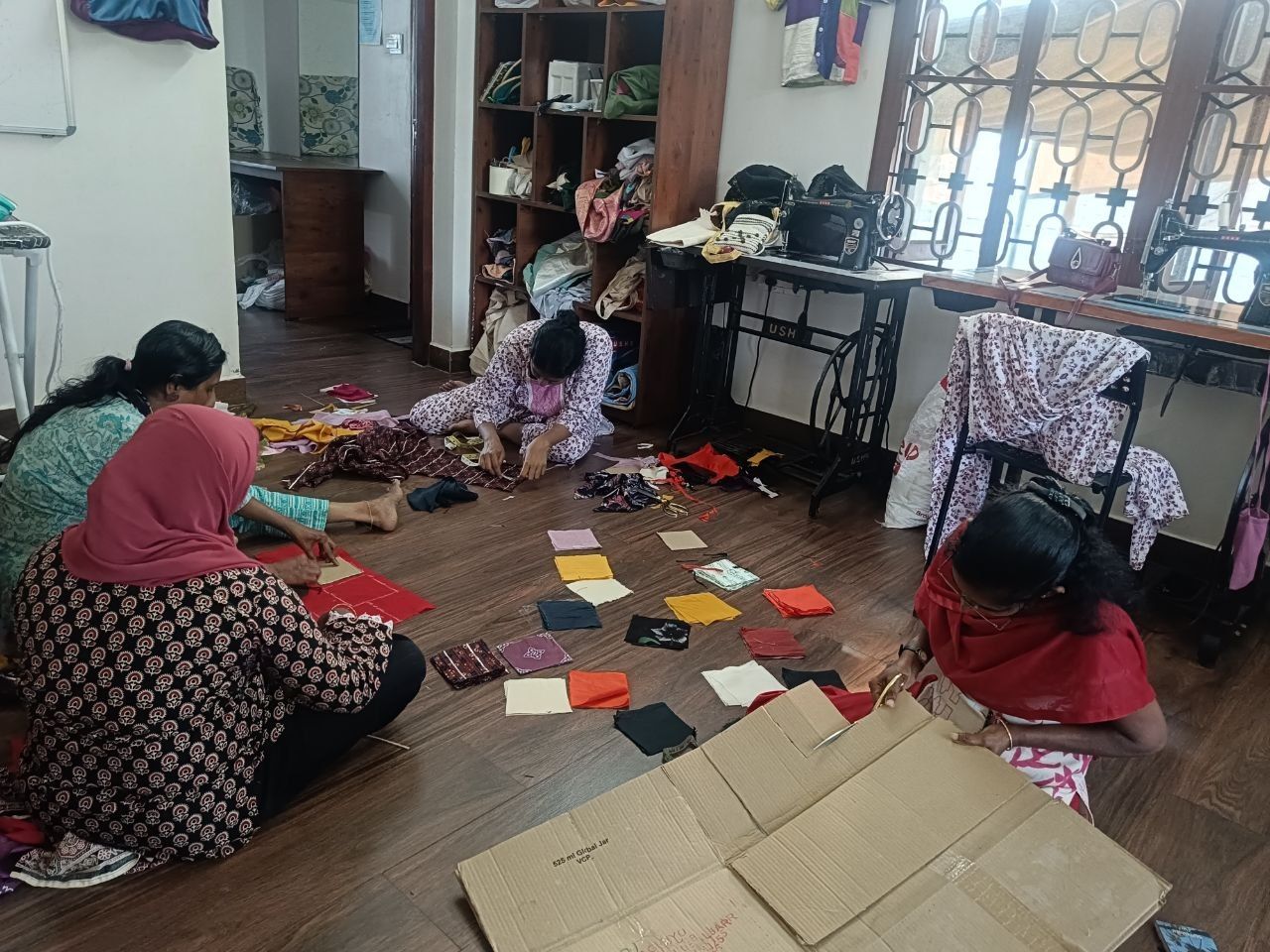
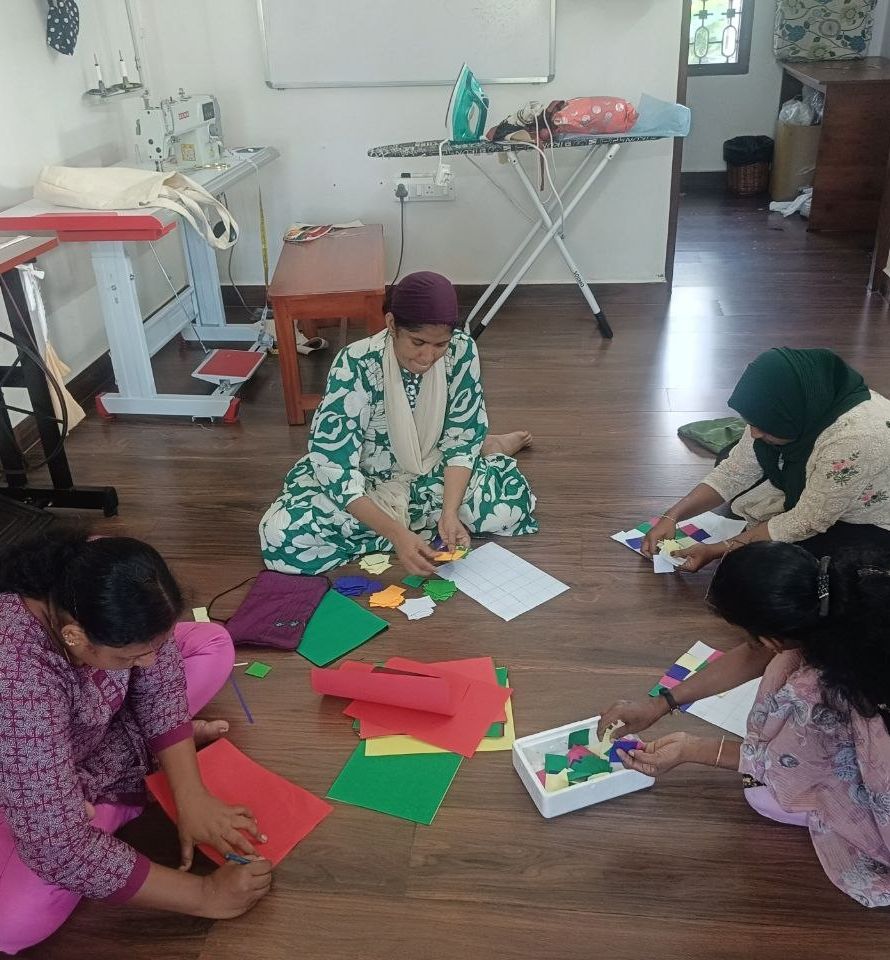
The Stitching Club at aikyam space is in Fort Kochi, Kerala, India. It began in March 2026 with members mending their own clothes (aikyam space, 27 March 2026 (opens in a new tab)). It moved on to tote bags and, from September 2026, to Kantha panels. Its first Kantha session was on 8 September 2026 (aikyam space, 8 September 2026 (opens in a new tab)). Its first full panel was finished on 23 September 2026 (aikyam space, 23 September 2026 (opens in a new tab)). The case study tells more.
Two of the club’s habits help any group.
- Grouping by skill. Before a bag order, the club grouped members from beginners to experienced stitchers who could show others how (aikyam space, 1 June 2026 (opens in a new tab)).
- Peers help peers. Intermediate members guided beginners step by step (aikyam space, 22 May 2026 (opens in a new tab)).
Two sessions, step by step
We have no measured time for a session. Try one panel first and note how long it takes. This plan splits the work into two sessions so that the cloth is ready before the studio is open.
Before the first session
- Ask members to bring clean, washed and ironed scraps of cotton or linen. Set aside stretchy, sheer and thick cloth.
Session 1: cut and photograph
- Make a template from a plastic lid. The Help page shows how.
- Cut the cloth into squares of 6 × 6 cm.
- Open the studio. Photograph each kind of cloth in daylight and say how many squares of it you cut.
Session 2: design and stitch
- Choose a pattern and print the sheet at 100%.
- Check one printed square with a ruler. It must measure 4 cm.
- Lay the squares column by column on the backing cloth.
- Stitch rows of running stitch.
A panel needs 35 squares. A group can share the cutting and the stitching between members.
Selling the group’s work
A group that wants to test selling what it makes can use the same questions as a small business: time, cloth, price, small batches, quality and roles. They are listed on the page for upcycling businesses. A group also needs to decide who takes an order, who delivers it and who receives the payment.
Where to start
Open the studio. It starts with a Sample box of real cloth, so the group can try a pattern before it photographs any cloth of its own. Then follow the Help page step by step.
We offer this as a guide only. The decisions about cloth, people and selling belong to the group.