The studio for a small business
An upcycling business turns waste cloth into something people want to buy. The hard part is planning: how to use mixed offcuts well, and how to repeat the result. Kantha helps with both, and the next two sections say how.
A maker photographs each kind of cloth, and the studio measures its colour and fills a box. The maker then picks one of eleven patterns, and the studio arranges the squares to fit it. The printed sheet is a plan the whole team can follow. See how Kantha works.
Kantha is a design studio for one panel of 35 squares. It does not plan a quilt, cost a job or manage stock.
Making the same panel again
- Press a pattern until the arrangement is the one you want.
- Save the design.
- Print the sheet again for each new panel.
A saved design and its printed sheet can be printed again for as long as the cloth lasts. Pressing the pattern again gives a new arrangement, so stop pressing once you have saved the one you want. When a cloth runs out, you cannot make that panel again.
The sheet prints on A4 only. A panel is 28 cm tall at true size, so it does not fit Letter paper.
If your team uses more than one device
One device holds the design. Boxes, cloth photos and designs stay on that device. The printed sheet shares the design with the rest of the team. To move everything to another device, use the backup file in the studio’s Menu (Back up or move to another device). Opening a backup replaces the designs and boxes on the device that opens it, so save a backup of that device first.
Product photos
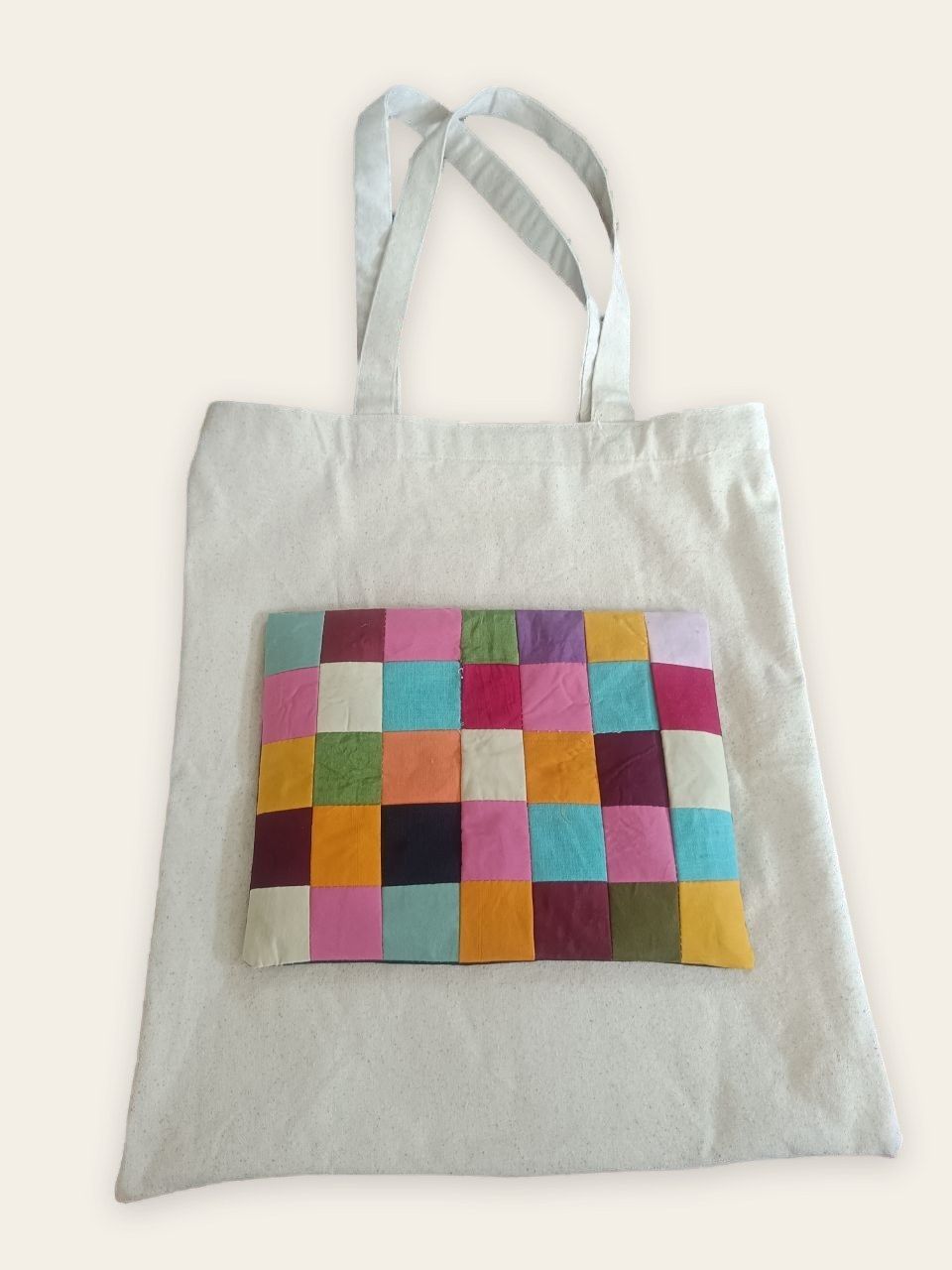
The Preview tab shows the panel in a frame and on a tote bag. Use it to see the finished product before you stitch, and to take pictures for a shop page or a customer.
What one club did
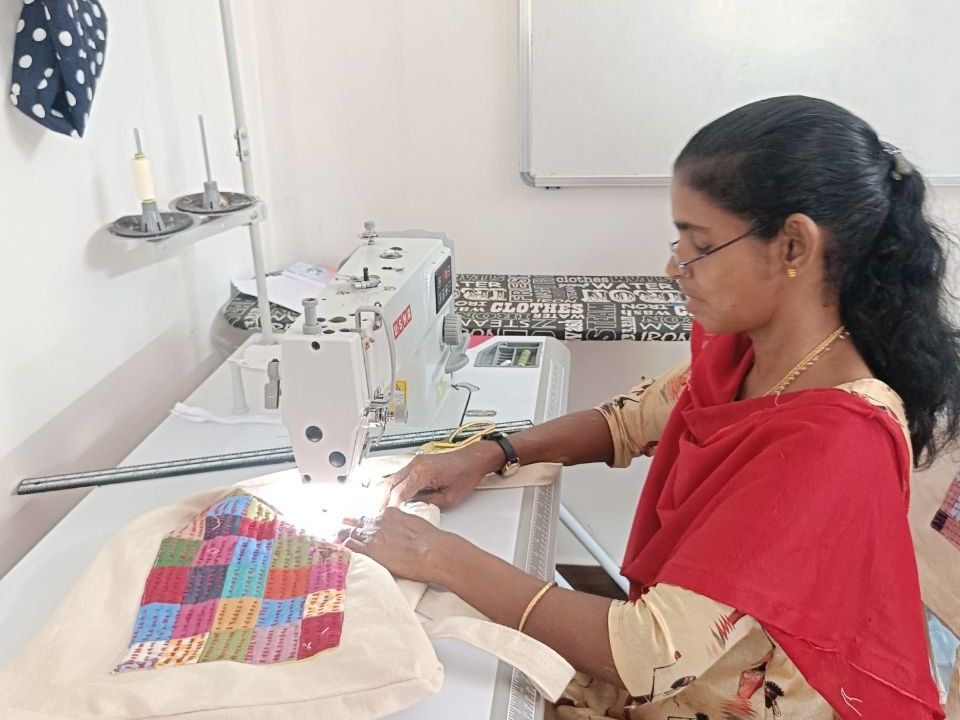
The Stitching Club at aikyam space, in Fort Kochi, Kerala, India, makes tote bags and Kantha panels from cut pieces of cloth. We describe it as one example, not a model every business must follow. The case study has its story.
- Sourcing. A community member collected fabric headed for landfill from local tailor shops and boutiques (aikyam space, 11 April 2026 (opens in a new tab)). Later the club found that many pieces were not good enough for quality products. Members went looking for better ones (aikyam space, 8 July 2026 (opens in a new tab)).
- Orders. The club finished a first batch of tote bags and started a second (aikyam space, 11 June 2026 (opens in a new tab)).
- Stock. The team planned to keep a minimum stock of five designs each month, so it was ready for new orders (aikyam space, 8 August 2026 (opens in a new tab)).
Checking whether a product can sell
We do not give prices, because they depend on the place and the buyer. These are the questions to answer, in this order.
- Time. Time the whole job on one panel: sorting, cutting, washing, ironing, stitching and finishing. Time a second panel and compare.
- Cloth. What does the cloth cost, if anything? What value does the maker put on their time? Count all the cloth the job used, not only the pieces that look good.
- Price. Add the time and the cloth. Compare the total with the local market price of similar handmade goods. A gap between the two may mean changing the design as well as the price.
- Small batches. Make a few panels before taking orders. A small batch shows what goes wrong while it is cheap to fix. The club placed its bags in a shop to see how people reacted (aikyam space, 6 August 2026 (opens in a new tab)).
- Where to sell. A local shop, a market, a gift stall, an online shop or a direct order from a customer. Each asks for different photos, packing and delivery.
- Orders. Write down what a customer ordered, the date promised and who is responsible. A missed brief wastes cloth. After the club misread a design brief, three bags came out in the wrong form (aikyam space, 19 June 2026 (opens in a new tab)).
- Roles. Name who measures, who cuts, who stitches and who finishes. The club split its bag production into those four jobs (aikyam space, 8 June 2026 (opens in a new tab)). A team of any size can use them, even if one person does more than one.
Quality checks
A printed sheet gives a clear standard, because every square must measure 4 cm. Add checks to suit the product.
- Measure. Check one square with a ruler before any cutting.
- Test the stitch. The club set up four stitch variations to compare side by side for neatness, stitch density and visual finish, to set a standard for its stitching (aikyam space, 30 September 2026 (opens in a new tab)).
- Check the finish. The club pulled two bags from a batch for iron stains (aikyam space, 27 June 2026 (opens in a new tab)).
Where to start
Open the studio and try the Sample box. Then read the Help page and the post on how to cut and photograph cloth squares. We offer this as a guide only.